DDR5 power consumption advantages are changing how engineers evaluate memory performance, thermals, and total operating cost. JEDEC’s JESD79-5 standard sets DDR5’s nominal VDD and VDDQ voltage at 1.1 volts, compared with 1.2 volts for DDR4. That reduction looks modest. At scale, it matters. A data center rack filled with memory modules can produce measurable savings in electrical demand and cooling workload. Micron’s DDR5 technical materials also highlight on-module power management, improved signal integrity, and higher effective bandwidth. These features move some regulation closer to the memory chips.
The performance case is equally practical. DDR5 starts at 4,800 MT/s under the standard, while DDR4 commonly begins at 2,133 MT/s. Higher transfer rates can help servers process larger datasets, AI workloads, and virtual machines with fewer memory bottlenecks. TrendForce has repeatedly reported strong DDR5 adoption across servers and PCs, although market forecasts change quickly. Memory pricing, motherboard compatibility, and workload design still influence the real return.
Jim Handy, a semiconductor industry analyst at Objective Analysis, described DDR5 as “a major evolutionary step in memory technology.” His observation captures the opportunity, but not the entire story. Lower voltage does not guarantee lower system power. More modules, higher capacities, and aggressive performance settings can erase part of the benefit. Testing matters. A useful comparison should measure watts per workload, not memory voltage alone. This article examines the evidence, the trade-offs, and the practical DDR5 power consumption advantages for modern computing systems.
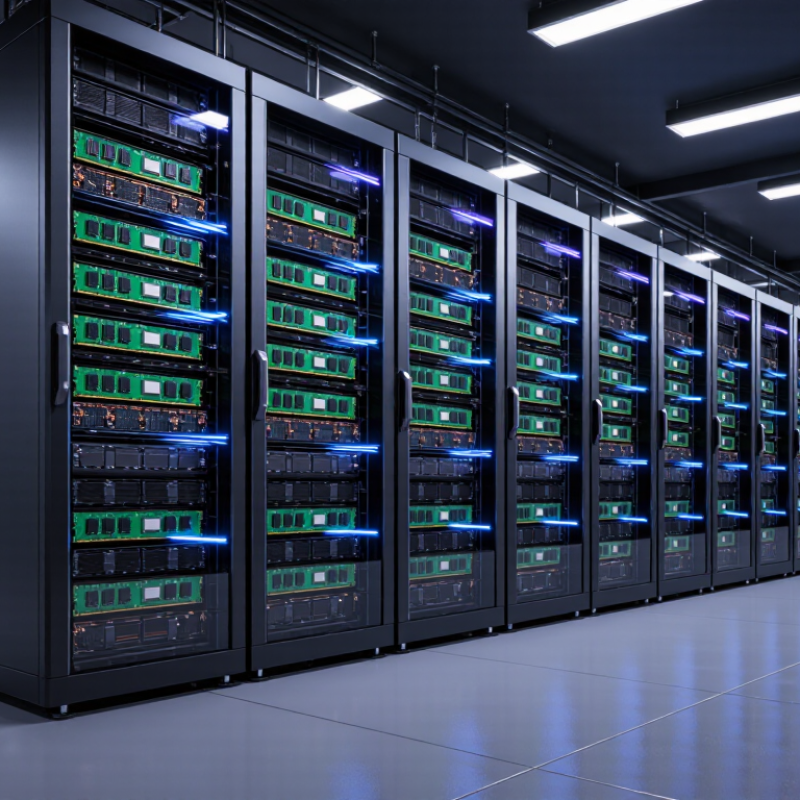
DDR5 power consumption begins with a lower operating voltage. JEDEC’s DDR5 SDRAM standard, JESD79-5, specifies 1.1 volts for core and I/O supply rails. DDR4 commonly uses 1.2 volts. This reduction lowers energy per transfer, especially during sustained memory activity. It does not mean every DDR5 module uses 8% less power, however. Speed, capacity, rank layout, refresh activity, and workload all change the result.
The power-management circuit now sits on the memory module, rather than mainly on the motherboard. This improves voltage control and can reduce delivery losses. A 32 GB module handling continuous compilation may draw noticeably more power than the same module during light office work. Short bursts are different. Idle behavior matters too. The exact figures require measurement at the wall or module rail, not a guess from voltage alone.
The broader energy context is significant. The International Energy Agency’s Energy and AI report estimates that data centers used about 415 TWh globally in 2024. Lawrence Berkeley National Laboratory’s 2024 report projects United States data-center electricity use could reach 325–580 TWh by 2028. DDR5 cannot solve that growth, but efficient memory can reduce one persistent load. I would avoid promising dramatic savings without matched testing. A practical comparison should use identical capacity, workload, airflow, and memory channels. Otherwise, the result may look precise while remaining misleading.
| Power or Design Dimension | DDR5 Characteristics | DDR4 Reference | Practical Advantage |
|---|---|---|---|
| Main DRAM supply voltage | 1.1 V nominal VDD/VDDQ | 1.2 V nominal VDD/VDDQ | The lower voltage reduces voltage-related energy use, although total module power is also affected by speed, capacity, and workload. |
| Voltage reduction | Approximately 8.3% lower nominal DRAM voltage than DDR4 | 1.2 V nominal DRAM voltage | Can help reduce dynamic power and heat at comparable operating conditions. |
| Power management | Power management circuitry is placed on the memory module to regulate and distribute power locally. | Power regulation is handled primarily on the motherboard. | Local regulation can improve power delivery control and signal quality, especially in high-density configurations. |
| Memory channels per module | Two independent 32-bit subchannels per standard 64-bit module | One 64-bit channel per standard module | Improves access granularity and can reduce unnecessary data movement during smaller memory transactions. |
| Burst length | BL16, with a fixed burst length of 16 transfers | BL8 is the standard burst length | Transfers more data per burst, helping improve bandwidth efficiency for sequential workloads. |
| Bank organization | Eight bank groups with four banks per group | Four bank groups with four banks per group | Provides more parallelism, which can improve performance per watt in workloads that keep multiple banks active. |
| On-die error correction | Includes on-die ECC inside the DRAM device | Does not include the same mandatory on-die ECC feature | Improves internal data reliability and supports higher-density memory technology; it is not a substitute for system-level ECC. |
| Standby and idle behavior | Uses lower nominal DRAM voltage and supports refined power-management features. | Uses a higher nominal DRAM voltage and an older power-delivery arrangement. | May reduce idle or light-load energy use, but the actual result depends on the platform and memory configuration. |
| Total module power | No single universal wattage; power varies with capacity, transfer rate, rank count, temperature, and workload. | Also varies by module specification and operating conditions. | DDR5 generally offers better energy efficiency potential, but a higher-speed or higher-capacity module can still consume more power than a basic DDR4 module. |
DDR5 commonly uses 1.1 volts for core and I/O power. This is lower than the 1.2 volts used by DDR4. Lower voltage can reduce switching losses and heat. Voltage alone is not enough.
No. Memory speed, capacity, module count, and workload change the result. A faster DDR5 setup may use more power during heavy activity. It may still finish tasks sooner. That difference matters.
Sustained compilation, rendering, and large data processing can increase memory activity. Active memory banks consume more power than idle banks. Continuous workloads also create more heat around the modules. Light office work usually demands less power. Short bursts behave differently.
Higher capacity often requires more memory chips. More chips can increase idle and active power. A 32 GB module may draw more power during continuous work. The exact increase depends on its design and operating speed. Capacity is not free.
The module controls voltage closer to the memory chips. This can reduce delivery losses and improve voltage stability. The circuit also produces some local heat. Airflow becomes important in crowded systems. That detail is easy to miss.
Poor airflow can raise memory temperature. Higher temperature may increase refresh activity and power use. A nearby fan can change readings more than expected. Crowded modules need careful cooling. Measure, do not assume.
Compare identical capacities, workloads, airflow, and memory channels. Record system power at the wall when possible. Test idle, office work, and sustained workloads. Energy per completed task is more useful than instant power alone. One short benchmark can mislead.
Yes, but the reduction is usually incremental. Lower memory power can reduce heat and cooling demand. The effect grows across many servers and long operating periods. Underused systems may show smaller savings. I would avoid dramatic promises.
DDR5 power consumption refers to the electrical energy used by DDR5 memory during active operation, standby, and performance transitions. Compared with DDR4, DDR5 generally operates at a lower standard voltage while introducing improved power management through on-module regulation. Its energy efficiency is also influenced by memory capacity, data transfer rate, workload intensity, operating temperature, and system configuration. These factors determine how much power the memory uses in real-world conditions rather than relying only on its rated specifications.
The main DDR5 power consumption advantages include reduced energy demand, lower heat generation, and improved efficiency for modern computers and data-intensive systems. Lower power use can support quieter cooling, more stable operation, and better energy management over long periods. To evaluate DDR5 power efficiency, users should compare power ratings under similar capacities and speeds, monitor consumption during different workloads, and consider performance per watt instead of power figures alone. This approach provides a more accurate understanding of how DDR5 balances speed, capacity, and energy use.

 Kryntel