How to Choose DDR5 Memory for Data Centers?

Time:2026-09-22 Author:Aria
0%

Choosing DDR5 memory for a data center is not simply a race for the highest frequency. It is a balance between capacity, bandwidth, latency, power, reliability, and platform compatibility. A server may advertise impressive speed, yet perform poorly when memory channels remain uneven or workloads trigger frequent data movement. The details matter.

Mark Adams, former Micron president, described DDR5 as “a significant step forward in performance and capacity.” That progress creates useful headroom for virtualization, artificial intelligence, analytics, and cloud databases. However, higher specifications do not automatically create better results. Engineers must match DDR5 memory for data center systems with the processor’s supported speed, registered DIMM design, error-correction requirements, and maximum channel population.

Start with the workload.

A database serving thousands of transactions may need low latency and balanced capacity. An AI server may prioritize bandwidth and sustained throughput. Virtualization hosts often need dense memory, predictable error handling, and room for future expansion. In real installations, technicians also check airflow, module placement, firmware support, and power budgets beside the rack.

JEDEC standards provide a foundation, but certification remains important. Vendor validation can reveal problems that a specification sheet hides, including unstable boot behavior or reduced speed across populated slots. This is where practical experience helps. I have seen seemingly minor configuration choices complicate maintenance later.

No selection is perfect. A cheaper module can become expensive when downtime, replacements, or limited upgrades enter the calculation. This guide examines the decisions behind DDR5 memory for data center deployments, helping teams compare technical performance with operational reliability.
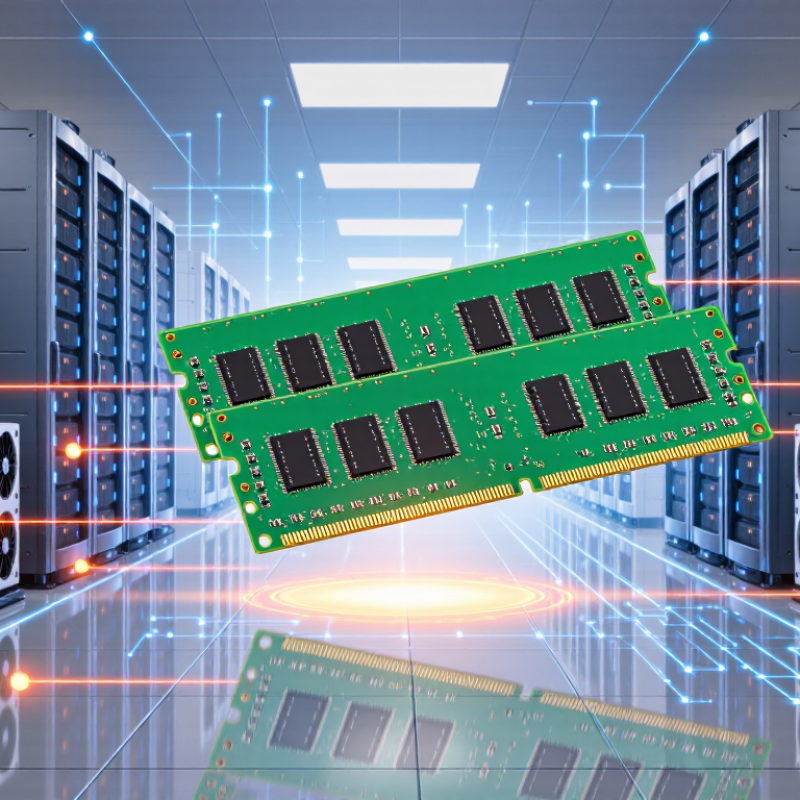
How to Choose DDR5 Memory for Data Centers?

DDR5 Memory Basics for Data Center Environments

DDR5 memory is more than a speed upgrade for data centers. It changes how servers handle bandwidth, power, and error control. The JEDEC JESD79-5 standard defines DDR5 features, including two independent 32-bit subchannels per module. Standard starting speeds commonly reach 4800 MT/s. Higher speeds are available, but compatibility matters more than impressive specifications.

DDR5 also operates near 1.1 volts, while moving power management onto the memory module. Its on-die error correction can repair some internal bit errors. It does not replace system-level ECC. That distinction is easy to miss. Select registered ECC modules that match the server platform, firmware, and processor memory rules. The IEA Electricity 2024 report estimates that data centers consumed about 460 TWh globally in 2022. Demand could exceed 1,000 TWh by 2026. Lower memory voltage may help, but cooling and DIMM density still influence total power use.

Tips: Begin with workload evidence. Database systems may value capacity and latency, while analytics platforms often need sustained bandwidth. Check supported module ranks and maximum capacity per socket. Test real applications, not only synthetic benchmarks. Uptime Institute’s Global Data Center Survey repeatedly identifies power problems and human error as major outage risks, so document installation steps and memory alerts. My own checklist can still fail when firmware changes. Leave room for validation.

Assessing Capacity, Speed, and Bandwidth Requirements

How to Choose DDR5 Memory for Data Centers?

Capacity should match the workload, not a procurement target. Review peak memory use, virtual machine density, database growth, and operating system overhead. Leave practical headroom for traffic spikes and maintenance events. A server with 512 GB may look sufficient today, yet become restrictive after several software upgrades. Memory pressure can trigger paging, which often hurts response time more than a modest processor limitation.

Speed matters when applications frequently move data between memory and the processor. Higher data rates can reduce transfer delays, but only when the platform supports them consistently. Check processor specifications, module population rules, and supported operating modes. Filling every memory slot may increase capacity while lowering the achievable speed. This trade-off is easy to miss during configuration. It is not perfect.

Bandwidth deserves workload-level testing. Scientific computing, analytics, and in-memory databases may benefit from multiple memory channels operating in parallel. Measure read bandwidth, write bandwidth, and latency with realistic data sizes. A synthetic benchmark can look impressive, then fail to represent production behavior. I have seen small datasets hide channel imbalance and create false confidence. Balanced module placement is essential, especially when several processors share access to memory. Record results under normal utilization, thermal limits, and failover conditions. Steady numbers matter more than a brief peak.

Comparing ECC, Registered, and Load-Reduced DDR5 Modules

Choosing DDR5 memory for a data center starts with understanding the module type, not just capacity. ECC adds error detection and correction, while registered modules place a register between the memory controller and DRAM chips. This reduces electrical loading and supports higher capacities. Load-reduced DIMMs add buffer technology for data signals, allowing even denser configurations.

ECC is essential for databases, virtualization, and long-running analytics. DDR5 also includes on-die ECC, but it does not replace module-level ECC. JEDEC’s JESD79-5C specification distinguishes these functions clearly. In practice, I would verify the server platform’s supported memory population before purchasing. A technically impressive module can still fail when mixed incorrectly.

Registered DDR5 modules suit most two-socket servers and balanced capacity plans. LRDIMMs become more attractive when each socket needs very large memory pools. The trade-off is cost, power, and sometimes higher latency. Uptime Institute’s 2023 Global Data Center Survey reported that 55% of operators experienced an outage within three years. Its findings also showed that about 16% reported outages costing more than one million dollars. Memory errors are not the only outage risk, but they deserve serious attention. I would compare corrected-error logs, thermal readings, and workload sensitivity rather than trust a simple specification sheet. The decision may remain imperfect. Reliability targets should guide capacity.

How to Choose DDR5 Memory for Data Centers? - Comparing ECC, Registered, and Load-Reduced DDR5 Modules

Comparison Dimension DDR5 ECC UDIMM DDR5 ECC RDIMM DDR5 ECC LRDIMM
Primary Design Unbuffered memory with on-module error-correction data bits Registered memory with a register and register clock driver between the memory controller and DRAM devices Registered memory with data buffers that reduce the electrical load presented to the memory controller
Error Protection Typically supports single-bit error correction and multi-bit error detection within each ECC word Typically supports the same ECC function as ECC UDIMMs, subject to platform implementation Typically supports the same ECC function as ECC RDIMMs, subject to platform implementation
Typical DDR5 Data Rates Commonly available around 4,800–5,600 MT/s; the actual rate depends on the platform and module configuration Commonly available around 4,800–6,400 MT/s; supported speed may decrease as capacity and population increase Commonly available around 4,800–6,400 MT/s; high-capacity configurations may require lower validated speeds
Typical Module Capacities Commonly 16–128 GB per module, depending on DRAM density and system support Commonly 16–256 GB per module, with larger capacities available on supported server platforms Commonly 128–512 GB per module; higher capacities depend on qualified memory architecture and server support
Electrical Loading Highest loading of the three options because the memory controller directly interfaces with the DRAM devices Lower controller loading than UDIMM because command and address signals are registered Lowest effective controller loading among the three because data buffers isolate the controller from DRAM devices
Maximum Memory Scalability Limited; generally suitable for smaller memory footprints and fewer modules per channel Strong; designed for multi-module server configurations and larger system memory capacities Very strong; designed for high-capacity systems where conventional RDIMM loading becomes a limitation
Latency Consideration Usually offers the lowest added buffering latency, but total latency still depends on speed and timings Adds register-related clock and command latency; the trade-off is better scalability and signal integrity Adds buffering latency beyond RDIMM; optimized for capacity rather than minimum access latency
Signal Integrity Adequate for lightly populated systems, but signal margins can narrow with more modules Improved command and address signal integrity for server-class memory population Best suited to dense configurations because data buffers reduce direct DRAM loading
Power Characteristics Generally the lowest module complexity and power among the three at similar capacity Additional register and clock-driver circuitry increases module power compared with UDIMM Data-buffer circuitry increases power draw compared with RDIMM, especially at high capacities
Compatibility Requires a platform that explicitly supports DDR5 ECC UDIMM; it is not interchangeable with RDIMM or LRDIMM Requires a server platform designed for DDR5 RDIMM; do not mix with UDIMM or LRDIMM Requires explicit server and firmware support; do not mix with UDIMM or RDIMM in the same memory system
Best-Fit Workloads Entry-level servers, edge systems, small databases, and workloads with modest memory requirements General-purpose servers, virtualization, databases, analytics, and most mainstream data-center deployments Large virtualization clusters, in-memory databases, analytics, and memory-intensive enterprise applications
Relative Cost Generally the lowest initial cost, but may require more system limitations as capacity grows Moderate cost with a strong balance between capacity, performance, and platform availability Usually the highest module cost, justified when maximum memory density is more important than minimum latency
Recommended Selection Rule Choose when the platform supports ECC UDIMM and the required memory capacity is relatively small Choose as the default option for most scalable DDR5 server deployments Choose when the server platform supports it and very high memory capacity per system is the priority

Note: Capacity, supported data rate, module population, timing, power, and maximum memory depend on the server platform, processor memory controller, firmware, and validated memory configuration. DDR5 modules normally operate at a nominal DRAM voltage of 1.1 V and include on-module power-management circuitry.

Checking Platform Compatibility and Memory Configuration

Choosing DDR5 memory for a data center starts with platform compatibility, not advertised speed. The processor must support the selected DDR5 generation, module type, capacity, and error-correction method. Server platforms commonly require registered ECC modules, while desktop-oriented modules may fail to boot. Check the platform’s qualified vendor list, socket limits, channel layout, and firmware version before ordering. JEDEC’s JESD79-5 standard defines DDR5 data rates up to 6,400 MT/s, but many systems reduce speed when all channels or memory slots are populated.

Configuration affects reliability and performance. Populate identical modules across balanced memory channels, especially in multi-socket servers. An uneven layout can leave one processor waiting for remote memory through NUMA interconnects. That delay is easy to miss in a basic benchmark. Use the platform manual, then validate with sustained workload tests. The 2024 Uptime Institute Global Data Center Survey reported that 54% of respondents experienced an outage during the previous three years, reinforcing the value of controlled deployment and fault-aware testing. Memory sparing, patrol scrubbing, and chip-level error correction should match the system’s availability requirements.

Capacity planning also needs restraint. A 256 GB module may appear efficient, yet it can increase cost and reduce future flexibility. Check the processor’s maximum memory capacity and the operating system’s limits. Firmware updates may improve compatibility, but they can also expose older module issues. I have seen configurations pass POST and still show lower bandwidth under full load. That is not a small detail. Treat vendor specifications as a starting point, not proof.

How to Choose DDR5 Memory for Data Centers? — Checking Platform Compatibility and Memory Configuration

DDR5 speed grades determine the theoretical bandwidth available per 64-bit memory channel. Select a module speed supported by the processor and motherboard, then verify module type, ECC support, rank limits, maximum capacity, and the permitted number of DIMMs per channel.

Bandwidth is calculated as data rate × 8 bytes per transfer. Actual application performance may be lower because of memory access patterns, channel utilization, platform limits, and the number of populated DIMMs per channel.

Balancing Performance, Reliability, Power, and Cost

How to Choose DDR5 Memory for Data Centers?

Choosing DDR5 memory for a data center starts with workload evidence, not maximum frequency. Database queries, virtual machines, and analytics pipelines stress memory differently. I have seen high-speed modules deliver little benefit when storage or network latency dominates. Measure bandwidth, latency, and memory errors during peak hours. A short test can expose assumptions. It may also reveal that planned capacity is too small.

Capacity often matters more than headline speed. Leave room for future virtual machines and larger datasets. Use error-correcting memory and platform support designed for continuous operation. Check ranks, module layout, supported densities, and channel population rules. Poorly balanced channels can reduce throughput. Test corrected-error rates after installation, not only during acceptance testing. Reliability is not a checkbox. Firmware compatibility, thermal monitoring, and spare inventory deserve equal attention. I once underestimated replacement delays; downtime risk outweighed a modest purchase saving. That mistake was expensive.

Power changes the economics. Compare operating voltage, thermal output, and performance per watt at rack level. A denser configuration may reduce server count but increase cooling demand. Calculate energy costs over three to five years, including workload growth. Avoid paying for speed that applications cannot use. However, choosing the cheapest modules can create validation and support costs. Document test results, traceability, and warranty terms. Independent benchmarks help, but local measurements carry more weight. Recheck the choice when software, processors, or power limits change.

FAQS

How much DDR5 memory does a data center server need?

Match capacity to peak workload, virtual machine density, database growth, and operating system overhead. Leave practical headroom. A 512 GB server may become restrictive after several upgrades. Memory pressure can cause paging and slower response times.

Does higher DDR5 speed always improve server performance?

No. Higher data rates help when applications frequently move data between memory and processors. The processor, module layout, and operating mode must support that speed. More modules can increase capacity but reduce the achievable data rate.

How should memory bandwidth be tested?

Test read bandwidth, write bandwidth, and latency with realistic production-sized data. Scientific workloads and in-memory databases may benefit from parallel memory channels. Small datasets can hide channel imbalance. Synthetic results may mislead.

Why is balanced memory placement important?

Install matching modules across balanced memory channels. This reduces remote-memory access in multi-socket systems. An uneven layout can leave one processor waiting for another socket’s memory. Basic tests may miss this delay.

What is the role of module-level ECC in DDR5 memory?

Module-level ECC detects and corrects certain memory errors during operation. It supports databases, virtualization, and long-running analytics. DDR5 on-die ECC does not replace module-level ECC. Reliability matters.

When should a data center use registered memory?

Registered modules suit many two-socket servers and balanced capacity plans. They reduce electrical loading between the memory controller and memory chips. This can support higher capacities. Confirm platform support before installation.

When are load-reduced modules worth considering?

Load-reduced modules may help when each processor requires a very large memory pool. They support denser configurations through additional buffering. However, they may increase cost, power use, or latency. The choice is not perfect.

What compatibility checks should be completed before ordering DDR5 memory?

Verify the processor generation, module type, capacity limits, error-correction method, and firmware version. Check supported socket limits and channel layouts. Also review the platform’s qualified module list. Passing startup checks is not enough.

How can administrators validate a new memory configuration?

Run sustained workload tests under normal utilization, thermal limits, and failover conditions. Review corrected-error logs, temperature readings, and bandwidth results. Test memory sparing, patrol scrubbing, and chip-level correction when available. Brief peak numbers can create false confidence.

Can filling every memory slot cause problems?

Yes. Full population may lower memory speed and reduce future upgrade flexibility. A large-capacity module can also increase cost and restrict later changes. Plan carefully. Yet real workloads should decide the final configuration, not a simple specification sheet.

Conclusion

Choosing DDR5 memory for data center environments requires more than selecting the highest available speed. DDR5 memory for data center applications offers improved bandwidth, greater capacity potential, and better power efficiency, but the right option depends on workload demands. Evaluate the memory capacity needed for virtualization, databases, analytics, and other intensive workloads, then compare speed and bandwidth requirements with the capabilities of the server platform.

Reliability and compatibility are equally important. ECC, registered, and load-reduced modules provide different levels of stability, scalability, and system support, so administrators should confirm which type is supported by the processor and motherboard. Memory channels, module population rules, and platform configuration should also be checked carefully. Finally, balance performance gains against power consumption, reliability goals, operating conditions, and total cost to create a practical, sustainable memory configuration for long-term data center operation.

Aria

Aria

Aria is a dedicated marketing professional with a deep passion for innovative strategies and a keen understanding of our company's product offerings. With a wealth of experience in the industry, Aria excels at crafting engaging content that highlights the unique features and benefits of our......